Reviewed · COMMUNIST HISTORY TOURS
Bucharest Under Communism: Life, Terror & Hope
This Bucharest walking tour is interesting because it turns the era of communism into visible landmarks, from Ceaușescu-style planning to the streets tied to the 1989 uprising. I love how the guide connects what you see in architecture with what life felt like under 45 years of communist rule.
I also like the human delivery, with standout guides such as Laura and Tamar bringing the story to life with clear explanations and supporting historical photos. One possible drawback: you will be outside for much of the route, so plan for a good-weather day, and be ready for heavy themes.
Key things that make this tour worth your time
- Small group feel (max 15 travelers) plus a private guide, so questions do not get lost
- Unirii Square shows late-communist grand planning, including the fountains and the former Victory of Socialism Boulevard
- Palace of the Parliament is explained in the context of forced sacrifice and 1980s shortages, not just as a big photo spot
- Mihai Voda Monastery highlights how some religious spaces survived while others were destroyed or hidden
- Revolution Square and 1989 locations connect Ceaușescu’s office, his last speech balcony, and the protest moments
- A ticketed stop at University Square focuses on the main protests against communism and the cost of dissent
A short route through a long, heavy era in Bucharest
If you want to understand Romania’s communist years, you need more than museum panels. This tour gives you a guided walk through the parts of Bucharest where political power left physical scars, from giant state symbolism to religious spaces that refused to disappear.
I like that the focus stays grounded in daily consequences, not just big names and slogans. You will hear how communism shaped everyday life in the capital, plus what happened as socialism shifted toward democracy.
And yes, some of the stories are hard. The Revolution of 1989 is covered through real protest locations, including where people gathered and where violence followed. You should go in with curiosity, but also with the mental readiness that this is not a light sightseeing loop.
More tours covering the communist period in Bucharest:
- The Real tour of Communism
★ 5.0 · 666 reviews - Life under Communism
★ 5.0 · 358 reviews - 3-Hour Guided Tour of Communist Bucharest
★ 4.9 · 303 reviews
Unirii Square: fountains, power, and the “Victory of Socialism” boulevard
You start at Piaţa Sfântul Anton, then head to the heart of the city for Stop 1 at Unirii Square. This is one of those places that makes sense fast because it is open and central, and it gives you that late-communist feeling of designed space.
Unirii Square was designed during the last phase of communism in Romania. You will notice the fountains, and you will also learn why the area matters in the story of Ceaușescu’s vision.
The key detail here is the former Victory of Socialism Boulevard, which cuts through the square. As you stroll on that boulevard, the scale helps you understand the megalomaniac planning behind the regime. In practical terms, it is a strong “set the stage” moment, because it frames what comes next: buildings and spaces meant to show who was in charge.
What to watch for: look past the obvious prettiness and pay attention to how the city’s layout reinforces political messaging. The guide’s job here is to show you the link between design choices and ideology.
The Palace of the Parliament: why bigger was never free
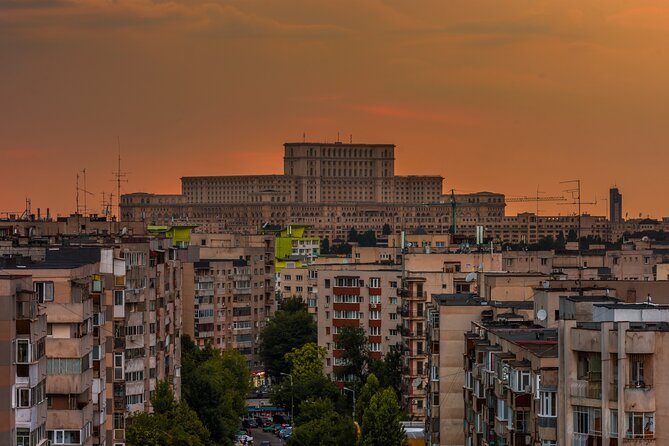
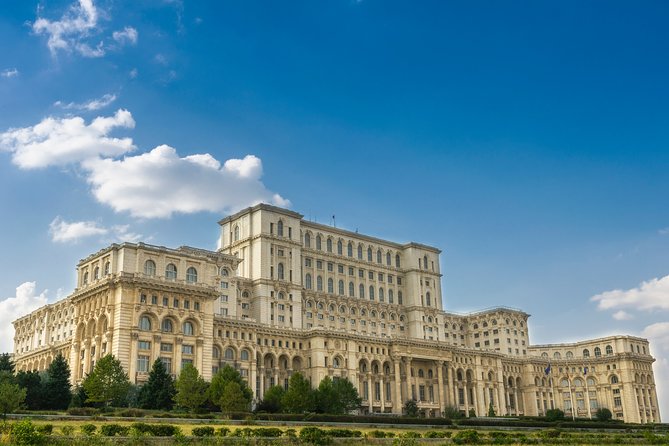
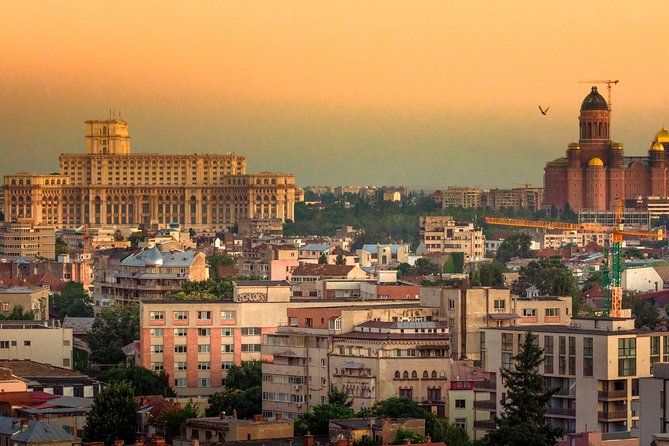
Stop 2 is Palace of the Parliament, a building people photograph because it is enormous, but this tour explains the human cost behind that size. You will hear why it is described as the second-largest building in the world after the Pentagon, and why it was also labeled the most expensive administrative building.
What makes this stop valuable is the angle. The story is not only about the palace’s scale. It is also about how vast amounts of money, materials, and labor were needed, and how during the 1980s Romanian people faced shortages of all kinds.
You will get to view the palace from different angles while hearing the full narrative of how such an enormous structure came to be. That helps, because without context, the palace can feel like a neutral monument. With context, you start seeing it as a message built on deprivation.
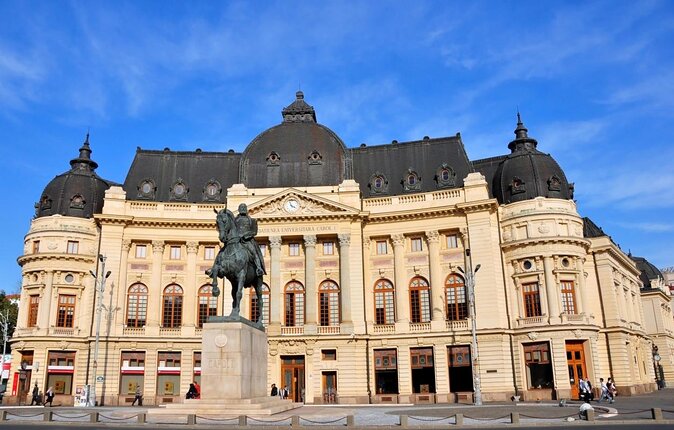
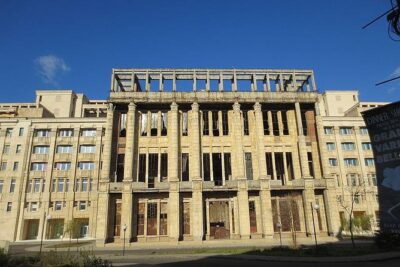
A neat extra detail you will likely notice across from the palace is the Academia Romana building, which shares the same broad style language. It was intended for the use of dictator’s wife, Elena Ceaușescu. That kind of information makes the surrounding skyline feel like part of a single planned political world, not random city architecture.
Ticket note: admission for this stop is not included. So if you are budget planning, set aside extra for the time inside.
Mihai Voda Monastery: religion survived in the gaps
At Stop 3, you shift from state power to something more personal: Mihai Voda Monastery and the church story under communism. This stop is short, but it is packed with meaning.
You will hear about the period when some churches were destroyed while others were saved, and you will see evidence of that compromise in the urban layout. Churches hidden behind utilitarian buildings look like an odd mismatch until the guide explains what the communist party did with religion. The effect is unsettling in a very specific way, because it shows religion not only as something suppressed, but also something physically pushed out of sight.
You will also learn that the Mihai Voda Church is from the Middle Ages and survived the demolition frenzy. That makes it feel like a time anchor, a place that holds onto the older Bucharest look while the world around it changed dramatically.
Ticket note: admission here is free, which is great because it keeps the pacing moving without extra cost or hassle.
If you like your history with visible details, this stop delivers. It is the kind of moment where the city itself feels like the archive.
A different kind of day out:
- Bucharest: Dracula’s Castle, Peles Castle, & Brasov Old Town
★ 4.5 · 17,858 reviews - Bucharest: Dracula Castle, Peles Castle & Brasov Old Town
★ 4.6 · 10,891 reviews - Bucharest: Dracula’s Castle, Peleș Castle & Brașov Day Trip
★ 4.5 · 5,919 reviews - Bucharest: Palace of Parliament Tickets and Guide
★ 4.3 · 3,182 reviews
Revolution Square: where communism began, and ended in public
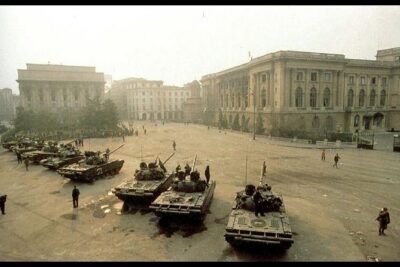
Stop 4 is Revolution Square (Piaţa Revoluţiei), and this is the emotional center of the walk. The square is tied to the start of the communist regime and, equally important, to the protests that marked the end during the Revolution of 1989.
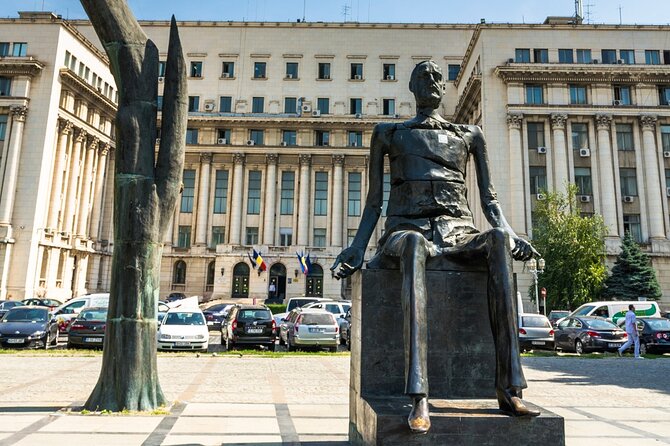
The guide points out key locations connected to Ceaușescu. You will see the building that housed his office and the balcony where he gave his last speech. You will also hear about the places where the first mass demonstration in Bucharest took place.
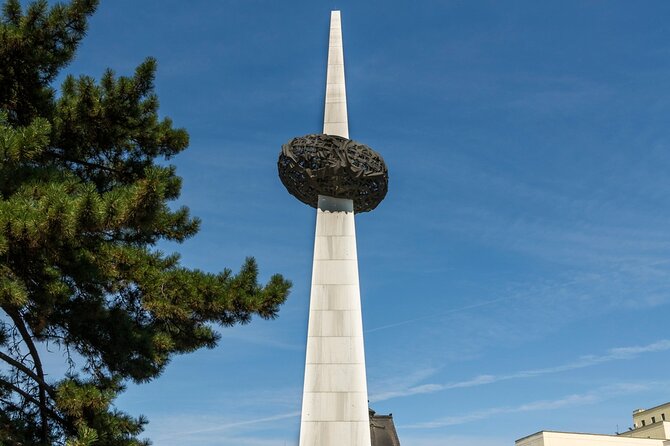
This is also where you learn what happened to those who demonstrated against totalitarianism. The tour explains the story behind the monument dedicated to them and what came next after the revolution. That means the stop is not only about what happened that day, it also covers the after-effects in how memory is shaped.
Ticket note: admission at this stop is free. So you can focus on absorbing the story without thinking about extra entry fees.
Practical tip: bring your questions. This is one of those locations where the guide’s explanations can help you connect what you read in history books with what you see on the ground.
University Square: the protests and the terrible price
Stop 5 is University Square, and this final history stop is not gentle. You will hear that this is where the main protests against communism took place in 1989, with hundreds being massacred for their belief in a free society.
This is the kind of stop where you should slow down, because you are not just looking at architecture. You are standing in a location linked to real decisions made under extreme pressure.
Ticket note: admission is included at this stop, so you do not need to budget separately for entry here.
When the walk ends, you finish at Revolution Square. The route description notes it is about 5 minutes away from the Old Town. That is handy because you can line up the rest of your evening with a post-tour plan, whether that is grabbing food nearby or using the Old Town area to process what you just learned.
What makes the guides work: Laura and Tamar, and how they teach
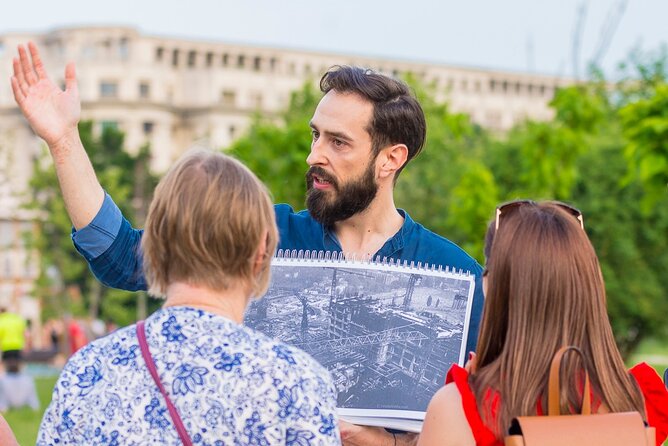
A big reason people rate this tour highly is the guide quality. In the comments you provided, Laura and Tamar come up again and again.
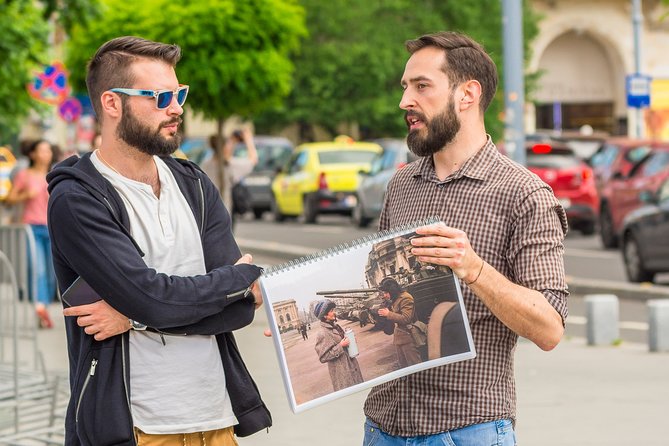
The consistent theme is that the guides explain clearly, stay interesting, and keep the group moving through a lot of content without turning it into a lecture. You will also see evidence of how they teach: additional historical photos are used to help you connect the dots between different parts of Bucharest.
There is also a sense of fun mixed into serious subject matter. Humor does not remove the darkness of the story, but it helps you keep listening. It also makes the walk feel less like a chore and more like you are getting personal context from someone who really cares about the subject.
The tour format matters too. It is private-guided and capped at a maximum of 15 travelers. That size is small enough that you can ask questions, but large enough that the experience still has a group energy.
Price and value: $23.22 for a 3.5-hour history walk
At $23.22 per person for about 3 hours and 30 minutes, this is priced like a budget-friendly guided walk rather than a major paid attraction circuit.
The value depends on what you want from Bucharest. If you are mostly interested in photos, you might feel like you are paying for explanations. If you want meaning, the pricing makes sense because you get multiple landmark stops tied to the same overarching story, plus a guide who helps you interpret what you are looking at.
Also, the tour structure includes several stops with free admission and only one major paid component where admission is not included, the Palace of the Parliament. That keeps the total day costs more predictable than tours where every stop is ticketed.
One caution on value: because the palace entry is not included, you should expect at least one extra expense if you plan to go inside during your allotted time.
Timing and logistics that matter for this route
The tour starts at 4:00 pm, so you are going to catch late-day light in many spots. That matters for two reasons: Bucharest’s big civic buildings often look better in softer light, and the walking rhythm feels more relaxed than a mid-day sprint.
It is also designed as a walking tour, so comfortable shoes are not optional. You will cover several distinct areas, including open squares and the long-feeling palace approach zones.
The meeting point is easy to locate: Piaţa Sfântul Anton 64, București 030167, Romania. You finish at Revolution Square (Piața Revoluției, București, Romania), near the Old Town.
One more practical note: the tour requires good weather. If conditions are poor, you should be ready for it to be rescheduled or adjusted, since outdoor time is part of the experience.
Who should book this tour, and who might skip it
You should book if you want a clear, guided way to understand communism in Bucharest, including Ceaușescu-era power, the built environment, and the 1989 revolution locations. It is especially worth it if you like history that points to specific places you can return to later on your own.
You might consider skipping or pairing it with lighter plans if:
- You prefer museum-based learning only
- You do not want to cover politically heavy topics
- You are visiting at a time when weather might be unstable, because much of the experience is outdoors
Should you book Bucharest under Communism?
Yes, I think it is a strong choice for first-time Bucharest visitors who want context. The route hits the big landmarks linked to communism, but it is the explanations that make the sights feel connected, not random.
If you are the type of traveler who reads plaques and still wonders what you are supposed to feel, this tour helps. And with guides like Laura and Tamar leading, you get clear storytelling, extra historical photos, and a small-group pace that keeps questions alive.
FAQ
Is this tour long or short?
It runs for about 3 hours and 30 minutes.
How much does the tour cost?
The price is $23.22 per person.
Where does the tour start?
The meeting point is Piaţa Sfântul Anton 64, București 030167, Romania.
Where does the tour end?
The tour ends at Revolution Square, Piața Revoluției, București, Romania.
What are the main stops during the walk?
You will visit Unirii Square, the Palace of the Parliament, Mihai Voda Monastery, Revolution Square, and University Square.
Is admission included for every stop?
Admission is free for Unirii Square, Mihai Voda Monastery, and Revolution Square. The Palace of the Parliament is not included. University Square has admission included.
What time does the tour begin?
The start time is 4:00 pm.
How many people are on the tour?
The tour has a maximum of 15 travelers.
What happens if the weather is bad?
The experience requires good weather. If it is canceled due to poor weather, you will be offered a different date or a full refund.
Can I cancel for a full refund?
Yes, you can cancel up to 24 hours in advance for a full refund. If you cancel less than 24 hours before the start time, the amount paid is not refunded.
Recently added around Bucharest
- Bucharest: Dealu Mare Winery Private Trip with Wine Tasting★ 4.9 · 6 reviews
- Winery touring & private wine tasting – one day private tour★ 5.0 · 3 reviews
- Traditions in Bucharest: Village Museum and Wine Tasting★ 5.0 · 8 reviews
- Village Museum Bucharest Guided Tour★ 5.0 · 6 reviews
- Your rendez-vous with Europe’s past: time-travel to Maramures, Transylvania★ 5.0 · 6 reviews
- Walking Tour of Bucharest City Center – Private Tour★ 5.0 · 4 reviews
- Wine tasting in Bucharest Old town – bonus cheese platter★ 4.5 · 6 reviews
- Private Wine Tasting at Bucharest’s First Wine Bar★ 5.0 · 3 reviews
Communist History Tours, compared.
Bucharest Essential Tour: Old Town, Calea Victoriei & Communism
Read our review →
Communism in Bucharest – Landmarks, Museum & Communist Appetizers
Read our review →


Museum of Communism Ticket with Communist Coffee
Read our review →Browse the lists this tour appears in